

Why Grounded? Why now?

“There is no shortcut to understanding intelligence. We must understand the brain.”
— Tomaso Poggio
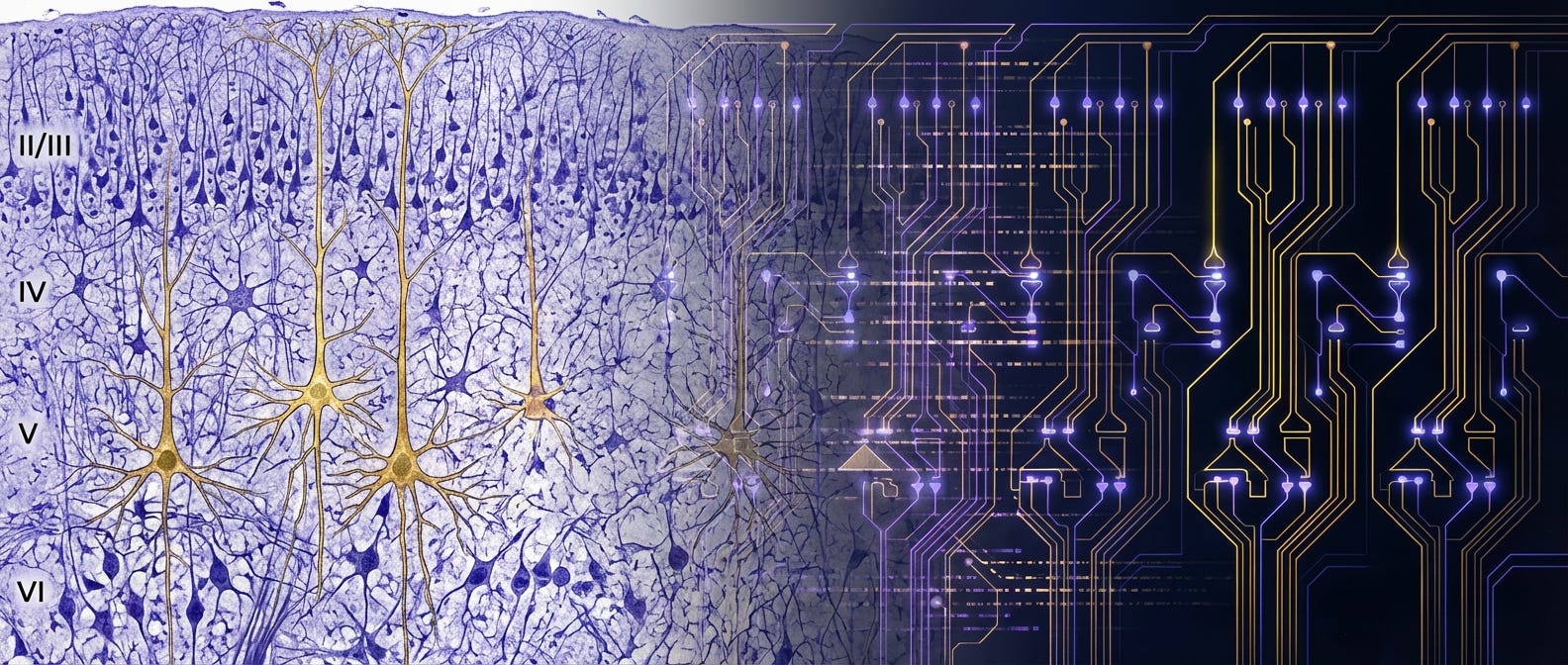
I’ve been building models of adaptive cortical microcircuits for almost two decades. Models that ask: How does the neocortex compute cognition? How do we get from molecular dynamics to structure learning and compositional thought?
The premise is simple but consequential: cognitive and behavioral processes are indissociable from their biophysical substrate. Neural computation isn’t an abstract information processing problem—it’s a biophysical phenomenon.
Understanding these processes requires bridging scales: nanometers to centimeters, milliseconds to years. It requires respecting biology while pursuing computational principles. It requires deep interdisciplinary integration combining psychology and cognitive science, physiology and medicine, computer science and machine learning. And it requires honesty about what we understand and what remains mysterious.
Such multidisciplinary approaches are demanding but increasingly necessary. Neurobiology poses hard, non-negligible constraints on the cognitive architecture; cognitive function imposes critical constraints on neural dynamics. The space of models that can account for any cognitive process is enormous. The best way to constrain it is to use the detailed biology of the brain—and its place in the natural world—as a guide, systematically decomposing the system into reusable components and operating principles causally linked to relevant computational aspects.
In this newsletter, I will document that pursuit.
Why now?
A few converging reasons:
Visibility matters. More than I’m comfortable admitting. Not for vanity, but for impact. Scientific progress happens through conversation: reading papers, discussing ideas, finding collaborators who see problems from complementary angles. Those conversations increasingly start online. If you’re not sharing your thinking, you’re invisible. Invisibility is a career killer. For decades, academic pursuits have been marked by the “publish or perish” motto, today even if you publish regularly in high impact journals, you may still perish. Being seen, sharing your thoughts and the products of your work is critical.
I’m much better at writing than networking. I’ve never been great at working a conference room. Small talk drains me. But give me something substantive—a paper, a model, a puzzle—and I can talk for hours. Writing is that, distilled. If I share how I think about cortical computation, I’m more likely to attract the people I actually want to work with: those who care about biological grounding, mechanistic rigor, scale-spanning thinking. I recently read this article by Joan Westenberg which explains this exact phenomenon. I’m not socially inapt and I do like to present my work to peers, but I am an introvert and my social battery has limited capacity. In a world where attention is currency and visibility gets you farther than depth, I want to make my voice heard by content. Writing is my preferred path.
I’m geographically isolated and fighting it. I recently returned to Portugal after almost 15 years in Germany, the UK and the Netherlands. Building a computational neuroscience research program at the University of Coimbra from scratch is both an incredible opportunity and an almost insurmountable challenge. The isolation isn’t just geographical, it’s intellectual. Portugal has brilliant researchers (heroically) doing fantastic work, but the kind of intersectional, multi-disciplinary research I do isn’t widely recognized or valued around here. Computational neuroscience barely exists as a field within the Portuguese research ecosystem (with the notable exception of the Champalimaud Foundation). Funding for this work is scarce. Opportunities are limited. Systemic and cultural challenges stand in the way of what should be straightforward progress in a fundamental research domain with tremendous scientific importance and practical implications.
I came back after a medical emergency halted my career trajectory in the Netherlands (I wrote about that here). With a newborn and serious health concerns, staying abroad without a support network wasn’t viable. The CNC offered a position to restart. But restarting means rebuilding from scratch in an environment where this type of work has no established infrastructure, limited institutional precedent, and few natural collaborators locally.
This newsletter is part of fighting that isolation—staying connected to the international community, making work happening here visible, attracting the collaborators and opportunities that don’t naturally find their way to Coimbra.
I think much better when I write. Always have. Speaking is messy for me—I lose threads, over-explain, assume too much context. Writing forces clarity. It exposes gaps in my thinking. It turns vague intuitions into testable claims. If this newsletter just helps me think more clearly, it’s already worth it. If it also helps others understand neural computation and cognition, even better.
What you’ll find here
This isn’t polished science communication. It’s lab notes made public showing the messy iteration towards mechanistic understanding, the overwhelming realization of the scope and depth of the problem and the (often counterproductive) competitive nature of academia. The notes will be divided into specialized pieces:
Field Notes — What we’re working on this week, what is happening, what we have been looking into. What’s clicking into place, what’s frustratingly stuck. Honest updates on building mechanistic, biophysically compatible models of cognitive computation. Published roughly weekly when there’s substantive progress to report and harnessed directly from research notes.
Journal Club — Papers discussed, why they matter, what questions they raise. Plus a running list of papers that crossed my path and sparked my interest but haven’t dug into yet. If you care about heterosynaptic plasticity, dendritic computation, spiking networks, or sequential, rule-based learning and compositionality, you’ll find leads here. Weekly when the reading warrants it.
Deep Dives & Opinion Pieces — Position pieces on where the field should (or shouldn’t) be heading. Critiques of lazy “brain-inspired AI” claims. Arguments for why biological constraints matter—not as limitations but as computational principles worth understanding. As topics demand attention. Naturally, these will be heavily skewed towards the main themes and research topics I am exploring (see below).
Expect weekly content (Field Notes or Journal Club), with opinion pieces as topics accumulate enough thinking to warrant them. Reply directly to any issue—I read and respond to everything (as time permits).
Core themes
The research areas you’ll see repeatedly:
Synaptic, dendritic and neuronal plasticity (and homeostasis) — How learning happens at the level of molecules, membranes, cells. Not abstractions—actual biophysical mechanisms, compatible with and validated against biophysical evidence.
Cortical microcircuits — What makes a canonical cortical circuit and what makes a canonical computation, how variations in molecular densities, cell types and numbers, connectivity patterns create functional specialization.
Sequential and compositional learning — How the neocortex represents structured temporal dependencies. The basis of working memory, language, hierarchical planning. Perception, production and abstraction, in a common descriptive framing.
Excitation-inhibition balance — How coupled plasticity stabilizes learning without sacrificing flexibility. How specialized inhibitory microcircuits control local information processing, memory formation and stabilization.
Meta-plasticity operators — When, where and how much is synaptic plasticity scaled relative to specific functional goals. What mechanisms underlie the adaptive control of synaptic and cellular plasticity.
Multi-scale integration — Bridging from biophysical mechanisms to cognitive function. The hard part. The part that matters.
Essentially, if you like computational neuroscience that takes biology seriously and aim to understand Human intelligence and cognition from the ground up, you’re in the right place.
What “grounded” means
Biologically grounded: I don’t believe in shortcuts. If a model violates known physiology or ignores molecular, cellular and architectural constraints, it’s not a model of the brain—it’s explaining a different system. Abstraction has its place in building intuition, but biological plausibility isn’t a nice-to-have; it’s the constraint that makes cortical computation possible. I’ve seen enough “studying the brain despite the brain” approaches. They don’t take us very far.
Electrically grounded: Neurons are electrochemical devices. Computation happens through ion flows, membrane potentials, synaptic conductances. Understanding mind requires understanding substrate.
Down-to-earth: No hand-waving. No overselling. If something isn’t working, I’ll say so. If a result is preliminary, I’ll be clear. Science advances through honest failure as much as polished success—and I mean to demonstrate that here, not just assert it. Tolerance to failure is mandatory in rigorous science. I’ll show the progress openly: successes and failures.
Who this is for
Primarily: Computational neuroscientists wanting to stay current on biophysically grounded modeling.
Also valuable for:
Cognitive scientists and computationalists curious about mechanistic implementations of memory, learning, compositionality
Neuroscientists linking synaptic mechanisms to circuit function
PhD students/postdocs navigating the messy reality of research careers
AI researchers who want to understand what biological brains actually do—not what metaphors suggest they do
If you care about understanding how the neocortex computes cognition through mechanistic models that respect neurobiology—not through analogy—subscribe.
What I’m hoping for
Conversations. Collaborations. Challenges.
If something I write sparks a question, reply. If you’re working on related problems, reach out. If you think I’m missing something critical, tell me.
Science progresses through collective scrutiny. Let’s do it together.
Welcome to Grounded.